
Flat roof drainage systems: Key considerations for design, installation and maintenance
Updated: 05. December 2025
Due to the rising frequency of heavy rainfall and storms, fast rainwater removal from flat rooftops has become critical to prevent structural damage and costly building repairs. This article explores the many considerations in flat roof drainage system design, installation and maintenance and introduces a market-leading siphonic roof drainage solution that offers superior performance, enhanced durability, and seamless integration with modern construction requirements.

Understanding flat roofing
Flat and low-slope roofs have become a favored choice for residential and commercial buildings thanks to their sleek, modern appearance, space efficiency, and adaptability to a variety of architectural designs.
- Flat roofs generally require less material and labor to install, offer easier, safer access for inspections, and can even serve as functional space for rooftop gardens, solar panels or recreational areas.
However, unlike sloped or pitched roofs, flat rooftops do not naturally shed water, making them susceptible to water accumulation, leaks and structural damage. This makes a quality drain system a necessity for flat roofs — otherwise, even a brief period of rain can lead to standing water, compromising the roof's structural integrity over time and shortening its lifespan.
New challenge for flat roofing: Extreme weather
In recent years, Europe has experienced a shift toward a warmer and wetter climate. Extreme weather events are now more frequent, with heavy downpours occurring even in regions where they were rare. These changing weather patterns have placed increasing pressure on property drainage infrastructure, most of which was not designed to handle today's climate conditions.
- Today's roofing materials must withstand heavy rainfall, flash floods and strong wind loads.
- Additionally, rising temperatures and increasingly frequent heat waves necessitate careful consideration of the UV and heat resistance of the selected materials.

Types of drainage solutions for flat roofs
Several solutions for flat roof draining are available, each offering its own benefits and limitations depending on the roof's size and design. By understanding the advantages of each drainage system type, building owners and designers can select the most suitable option for their specific flat roofing needs.
- Small-to-medium roofs: Scupper drains are small openings placed along the roof's edge or parapet walls. Also called external drains, they provide a simple and cost-effective way to direct water off small rooftops. Scupper drains can be combined with gutters and downspouts to divert water flow to the desired area.
- Small-to-medium roofs: Gravity systems with central drains are a popular choice for average-sized flat roofs. The outlets are positioned at the lowest points of the roof surface, relying on gravity to collect water. Since a greater number of drainage points must be installed across the entire rooftop to ensure efficient water drainage, the so-called central or internal drains guide water into the plumbing system, keeping the building's exterior clean and uncluttered. Tapered insulation can be added to create a gentle slope, helping direct water toward designated drainage points.
- Large roofs: For large-scale residential, industrial and commercial buildings, siphonic drainage systems are the most effective solution. Siphonic (or vacuum) systems use negative pressure to rapidly draw water from the entire roof surface. Due to their high efficiency, fewer pipes and outlets are needed. Furthermore, as siphonic systems do not rely on gravity, internal drains can be laid without slope, maximizing the available interior space.

Best-performing drainage system for large flat roofs: Test results
In response to current climate challenges, Pipelife has developed an industry-leading siphonic roof drainage solution that exceeds current safety and efficiency standards. The solution is designed for flat roofs with up to a 3% incline and a minimum area of 150 m2, and is fully compatible with cold, insulated, inverted and green roofs.
An innovative outlet design is at the core of the new system. Pipelife's DN75 siphonic drainage outlets have been tested to deliver a flow rate of up to 20 l/s — surpassing standard siphonic systems by 60%.
Pipelife's air baffles are made from an automotive-grade ASA thermoplastic, ensuring superior UV, abrasion and impact resistance. The system's service life is at least 50 years, matching the building's expected lifetime.
"The final product exceeds customer expectations for flat roof drainage solutions, offering the highest flow rate on the market for a standard 75-mm outlet," states Ivan Milenovic, Business Development Manager at Pipelife.
Installation advantages of Pipelife's siphonic roof drains
Pipelife's siphonic system has been designed for fast, efficient and error-free installation:
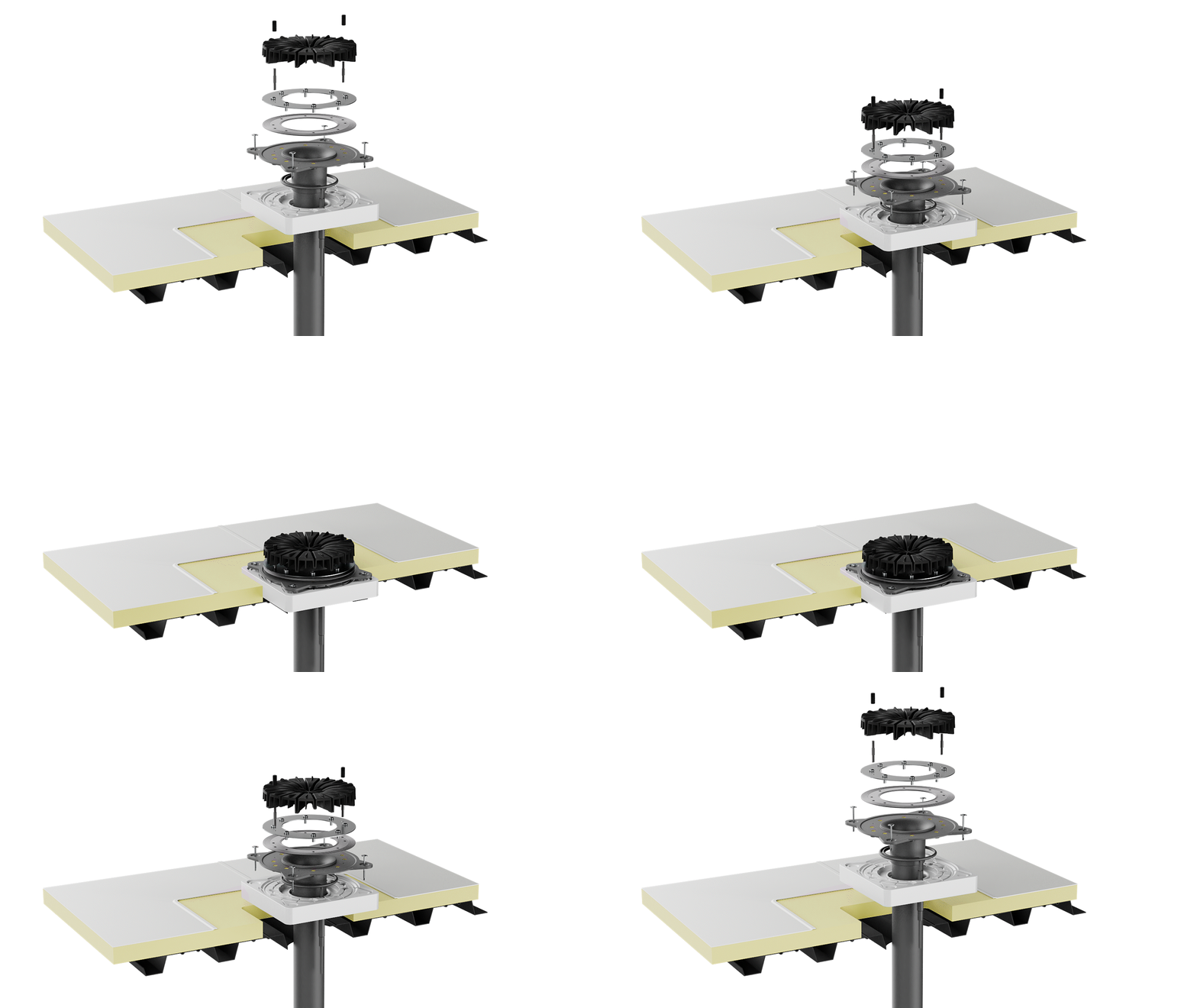
- Each outlet is preassembled at Pipelife's factory, welded to an adjoining 50-cm tailpipe, and preconnected to an insulation block and waterproof membrane — ensuring a quick, watertight connection.
- The prefabricated outlets are available with various roofing membranes, including PVC-, bitumen-, TPO/FPO and PVB systems.
- The air baffle itself can be installed and removed without tools, thanks to nut fasteners.
- A wide range of compatible HDPE pipe systems and fittings is available for both butt-welding and electrofusion jointing.
"Compared to standard, non-preassembled siphonic systems, we're seeing an installation speed increase of at least 15–20%," notes Milenovic. "Since all parts come from a single supplier, the system's overall reliability is exceptionally high, ensuring optimal performance and exceptional service life."
Designing siphonic flat roof drainage systems
Proper flat roof drainage design is crucial for the system's effectiveness and optimal performance. Optimal outlet placement and properly sized primary drains ensure rapid self-priming — system operation in siphonic (full-bore) flow. Design errors can cause air to enter roof drains, resulting in slower water flow and water accumulation.
· Proper drainage system design must account for both typical precipitation levels and forecast peak flows.
The most cost-effective approach is to design a primary drainage system for normal rainfall intensities and add a secondary (overflow) system that serves as an alternative escape route if the main drains become blocked or overwhelmed.
As proper drainage system design can be complex, especially for large roof surfaces, Pipelife offers dimensioning and design services to ensure each project is equipped with the correct parameters for optimal system effectiveness.
Based on data from architects and building services engineers, Pipelife's designers create an isometric drawing along with a complete list of required components, specifications and cost estimates.
A comprehensive BIM library of system assets is available for customers who prefer to develop their own designs.
Given that modifications and deviations from the original construction plan are common, Pipelife also provides continuous design support to its customers throughout the entire project lifecycle.
"Our experts stay in close contact with customers not only during the design and delivery phases but also throughout installation," emphasizes Milenovic. "Unexpected changes can arise during flat roof construction. When they do, we help our customers find the best solution."
Making flat roof maintenance effortless
Debris buildup is one of the most common causes of improper drainage and standing water on flat roofs. Whether due to suboptimal design or insufficient maintenance, silt, leaves, dirt, and other debris can lead to blockages, overflows and standing water. Routine maintenance inspections are important, but, depending on the system's design, can become time-consuming and costly.
Pipelife's siphonic roof drainage systems are self-cleaning and require minimal maintenance. Due to the perfectly smooth inner pipe surface and the very high water-discharge speed, debris that might have entered the system is naturally flushed away. If cleaning of the air baffles is needed, they can be quickly removed and reattached without tools.

Future-proof roof drainage solutions for a changing climate
With flat roofing now a defining element of contemporary architecture, the need for robust water-management systems has never been greater — across residential, industrial or commercial buildings alike.
Compared with traditional drainage systems, Pipelife's siphonic solutions offer significantly higher flow efficiency, greater durability and safer installation, ensuring effective drainage throughout the building's lifecycle.
In addition, Pipelife's siphonic solutions can be integrated with other systems for rainwater infiltration, storage and reuse, for a comprehensive, end-to-end stormwater management strategy.
Questions and answers
1. WHAT IS A FLAT ROOF?
In the building industry, the term 'flat roof' refers to rooftops that are almost level or have a pitch of less than 10 degrees. Flat roofs have become particularly popular in modern architecture and for large-scale commercial or industrial buildings.
2. WHAT ARE THE BEST MATERIALS FOR FLAT ROOFING?
Flat roofs require expert design, as they lack natural runoff. Even the choice of roofing materials can play a significant role: traditional materials like asphalt and concrete, while durable, can sometimes contribute to water pooling if not paired with a high-efficiency drainage solution.
The slope and texture of the roofing material influence how efficiently water flows toward the drain openings. Incorporating a slight slope into the roof design helps direct water to the designated drainage area, while selecting materials with a smooth surface reduces friction and allows water to move more freely.
3. WHY IS FLAT ROOF DRAINAGE IMPORTANT?
Unlike sloped roofs, flat rooftops can't rely on gravity alone to prevent water from pooling. Modern roof drainage solutions can withstand heavy rainfall and wind loads, preventing leaks and structural damage.
4. HOW TO CHOOSE THE BEST DRAINAGE SYSTEM FOR A FLAT ROOF?
Selecting the right drainage solution depends on the building's size, climate, architectural design and maintenance capacity. Scuppers and gutters are popular for smaller, residential buildings.
Gravity systems with internal drains, and especially, siphonic systems, are recommended for large commercial or industrial flat roofs.
Independent of the system selected, regular maintenance and inspections are crucial for its proper performance.
5. WHAT SHOULD BE CONSIDERED IN FLAT ROOF DRAINAGE SYSTEM DESIGN?
The primary function of a roof drainage system is draining water: the design must be hydraulically balanced to cope with both normal rainfall and extreme weather.
Locations, spacing and sizing of primary outlets and interior drains must be carefully planned.
The design should also include a secondary or overflow system to handle peak precipitation.
6. WHAT IS THE BEST ROOF DRAINAGE SYSTEM FOR COMMERCIAL BUILDINGS?
In industrial and commercial environments, managing roof drainage is critical, as excess water accumulation can cause structural damage, severe financial loss and operational disruptions.
By combining high-performance outlets with space-saving interior drainage designs, siphonic roof drain systems are considered the most effective option for large industrial or commercial flat roofs.
7. HOW TO INSTALL FLAT ROOF DRAINAGE?
Proper installation is essential for the effectiveness and safety of all roof drainage systems, but is of particular importance when it comes to flat roofing. The installation should be performed by certified roofing professionals only and in accordance with local building codes.
An improperly installed system can cause water pooling, leaks and mold growth, potentially leading to structural damage or even roof collapse.
8. HOW TO MAINTAIN FLAT ROOF DRAINAGE SYSTEMS?
Regular maintenance of drainage components is vital to keep them free of debris and functioning as intended.
By keeping drain openings clear and regularly inspecting downspouts, gutters and the waterproof membrane, property owners can avoid water buildup related issues and extend the life of their flat roof.
9. ARE SIPHONIC DRAINAGE SYSTEMS COST-EFFECTIVE?
Siphonic systems, while sometimes requiring a higher initial investment, lead to long-term savings by reducing the need for frequent maintenance and potentially costly repairs.
These systems use fewer pipes and can handle higher water volumes, making them a valuable investment for large, industrial or commercial properties where effective drainage is crucial.
Find out more about
Get in Touch
Please choose your preferred way to get in contact with us. We will get back to you as soon as possible.
Fill our form